The short answer
Cross the laces and tuck one under, make one loop, wrap the other lace around it, push that lace through the gap and pull both loops tight. Occupational therapist Melissa Foster says “most children find it to be easier” to use two “bunny ear” loops, and sees kids learn “typically somewhere between 4-8 years of age.”
Shoe tying takes “a very precise sequence of fine motor movements,” as Foster puts it, so both therapy sources below teach it in small stages. More guides: our parent how-to section.
What you need
- A lace-up shoe off the foot. The OT Toolbox, an occupational therapy resource site, says to “Start practicing with the shoe NOT on the foot.”
- Two laces in different colors, tied together at the ends, so your child can tell them apart (an OT Toolbox tip).
- A practice board (optional). Kids’ shoe maker Superfit shows how to make one: cut a cardboard shoe shape and “Mark six holes on both sides of the shoe shape” for the lace.
- A marker (optional), to draw lines on the laces that set the size of the first loop (an OT Toolbox trick).
- A few minutes a day. The OT Toolbox’s first success tip: “Practice on a daily basis.”
Is your child ready? Four practice stages
Foster’s seven-item readiness list includes cutting simple shapes, buttoning large buttons, lacing boards and folding paper. If your child can do “the majority of the tasks listed,” she writes, “then you definitely have the green light to begin shoe tying.” The American Academy of Pediatrics (AAP) lists “Cutting (using safety scissors) and pasting” among activities 4- to 5-year-olds may enjoy.
Foster then works through four stages: a tying board, a sneaker on the table, your shoe on your foot, and finally your child’s own shoe. Her advice: “master step one before moving on.”
How to tie a shoe: the one-loop method
Foster calls this the “traditional” method.
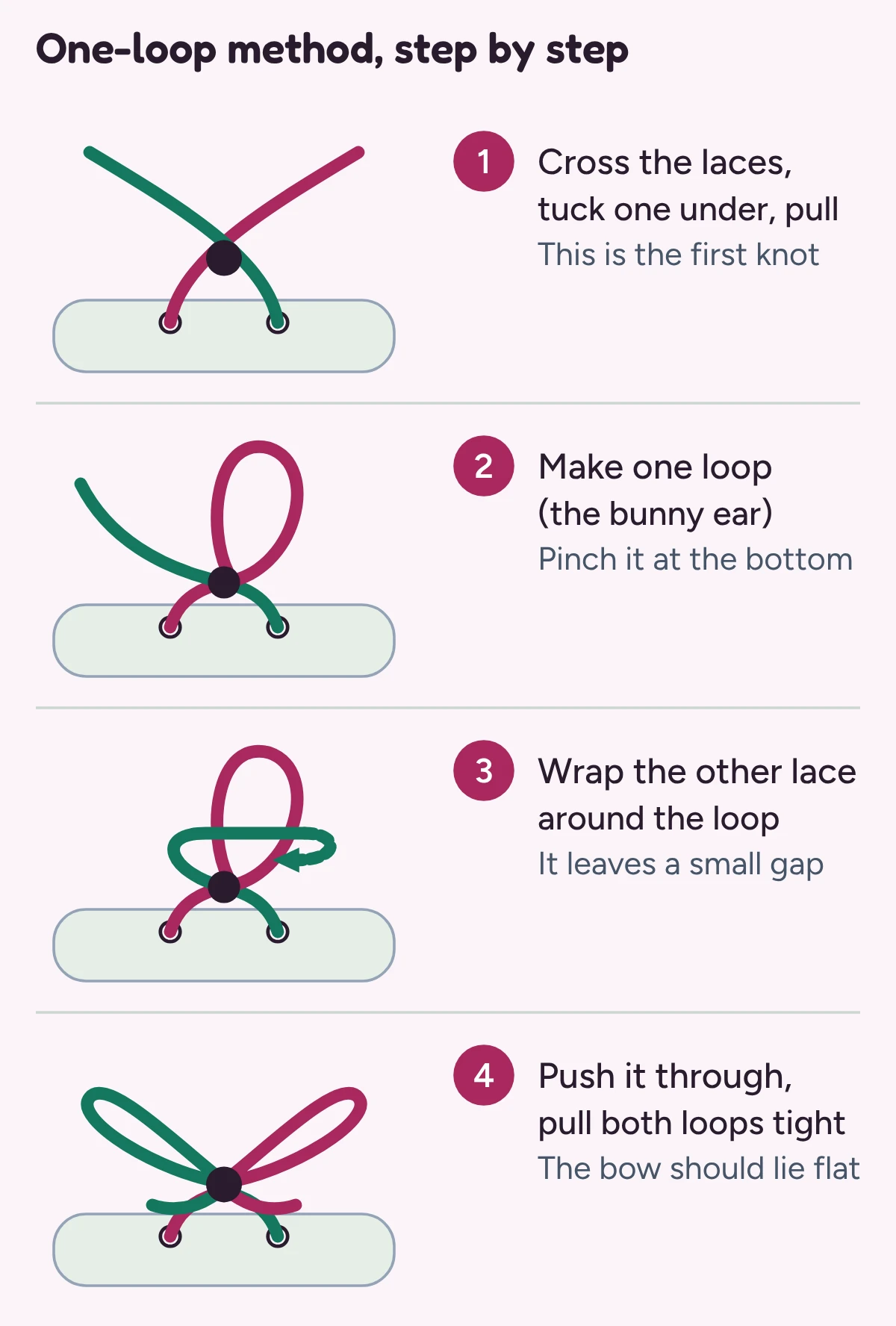
Cross the laces and pull
Hold one lace in each hand, cross them into an X, tuck the top lace under and pull both ends snug.
Make one loop
Fold one lace into a loop (the “bunny ear”) and pinch it at the bottom, close to the knot.
Wrap the other lace around the loop
Take the free lace around the front of the loop and behind it, leaving a small gap.
Push the lace through the gap
Superfit says to push it through “using the middle” of the lace, not the end, so it forms a second loop.
Pull both loops tight
Hold a loop in each hand and pull outward until the bow is firm.
The two-loop “bunny ears” method
Cross the laces and pull
Same as above.
Make two loops
Fold each lace into a bunny ear, one in each hand.
Cross the loops and pull
Cross the loops into an X, tuck one under and pull both loops outward.
Foster says “most children find it to be easier,” but “it is often not as tight a knot as the traditional method.” She shows both: “Then I ask the child which one looks easiest to him.”
Ready to buy?
For a no-tie option on wet days, see our roundup of kids’ wellies.
When do kids learn to tie shoes?
The sources’ ages differ; we found no deadline in them:
| Age | What the source says | Source |
|---|---|---|
| 3 years | Suggests “Dressing and undressing dolls in clothing with large zippers, snaps and laces” for hand skills | AAP, HealthyChildren.org |
| 4 to 5 years | A child “may even be able to tie their shoes” | AAP, HealthyChildren.org |
| By 5 years | Lists “Buttons some buttons” under movement; we found no shoe-tying item | CDC milestone page |
| 5 to 6 years | Parents can teach it “when they are around five to six years old” | Superfit (shoe maker) |
| 4 to 8 years | “Many developmental charts say 5 years,” but she sees “typically somewhere between 4-8 years of age” | OT Melissa Foster |
The CDC defines milestones as “things most children (75% or more) can do by a certain age.” The OT Toolbox says shoe tying needs “many underlying skill areas that just aren’t developed at 5-6 years old.” Foster recalls her son’s soccer games stopping for players who needed lace help: “And these boys are 9!”
The same AAP page suggests simple jigsaw puzzles and “Coloring with crayons or chalk” for 3-year-olds; see our kids’ puzzles roundup and crayons for kids roundup.
Common mistakes and how to fix them
- The first loop is too big. “Many kids tend to make the 1st loop so large that there is no lace left to finish tying it,” says the OT Toolbox. Mark the laces.
- Repeating the first cross. “Some kids will continue to make the first cross step over and over again,” the site notes; its tips list adds: “Use simple terms and one-step directions.”
- Mirror confusion. The OT Toolbox says to “Sit behind the child so your hands are positioned the same as the child’s would be.” For left-handed children, Superfit suggests the reverse: “It is helpful to sit opposite the child.” Our suggestion: try both.
- The bow keeps coming undone. UC Berkeley engineers describe the weak bow as two crossings of the same handedness, “causing the knot to twist instead of lying flat when tightened.” Foster says a good bow lies “from ankle bone to ankle bone”; if the loops point toe to ankle, wrap the lace around the loop the other way.
- Tears and frustration. Superfit calls it “very important to remain patient.” Our suggestion: go back to the last stage your child did well.
Loose laces: the safety rules
Safety
A CPSC escalator safety release (May 13, 2008) advises: “Make sure shoes are tied before getting on an escalator.” It also says to “Always hold children’s hands” on escalators “and do not permit children to sit or play on the steps.” For bike rides, the AAP says: “Shoelaces should be tied securely.”
When to talk to your pediatrician
Your child’s doctor, not this page, can say whether a late start matters. When you have concerns about development, the CDC’s advice is: “Talk with your child’s doctor, share your concerns, and ask about developmental screening.” The AAP notes that “An OT evaluates the child’s fine motor skills,” and your pediatrician can say whether a referral makes sense.
Frequently Asked Questions
Q. What is the easiest way for kids to tie shoes?
Foster says most children find the two-loop “bunny ears” method easier, though its knot is often less tight.
Q. Can a 3-year-old learn to tie shoes?
The AAP suggests dressing dolls in clothes with laces at 3 and first mentions tying shoes at 4 to 5. Foster’s range starts at 4.
Q. Should a 7-year-old be able to tie his shoes?
Foster’s range runs to age 8, and she has seen 9-year-olds needing help. If you are worried, ask your pediatrician.
Q. Why can’t my 10-year-old tie his shoes?
We can’t tell you why; ask your pediatrician. Meanwhile, the OT Toolbox favors elastic laces with a sliding lock.
Q. Is tying shoes a developmental milestone?
The CDC’s 5-year checklist lists buttoning, not shoe tying. The AAP says a 4- to 5-year-old “may even” tie shoes.
Q. How do left-handed children learn to tie shoes?
Superfit says the steps are the same and suggests sitting opposite your child.
Sources (9)
- AAP, Hand and Finger Skills of Your Preschooler
- AAP, Biking
- AAP, Occupational Therapy
- CDC, Milestones by 5 Years
- CPSC, escalator safety release (2008)
- Melissa Foster, OTR/L, Teaching Kids to Tie their Shoes
- The OT Toolbox, Shoe Tying Tips
- Superfit, Learning to tie shoelaces
- UC Berkeley Mechanical Engineering, news on the O’Reilly lab shoelace knot study